
Terra’s House
You can think of Terra like a character that Joe Pesci would play in any film he was ever in. She moved through the world with a kinetic paranoia, as though everyone was a wrong look away from needing to be corrected—loudly, violently, or with a punchline. Simultaneously, she was the acting manager for the Muse's, all too happy to bust your balls before you got an audition with one of The Fate’s favorite daughters, and I was oddly grateful to oblige. She was like a medieval gatekeeper, and although she didn’t use the chaotic language Richard and I typically did, she would let some psycho-babble slip through her carefully curated persona now and then.
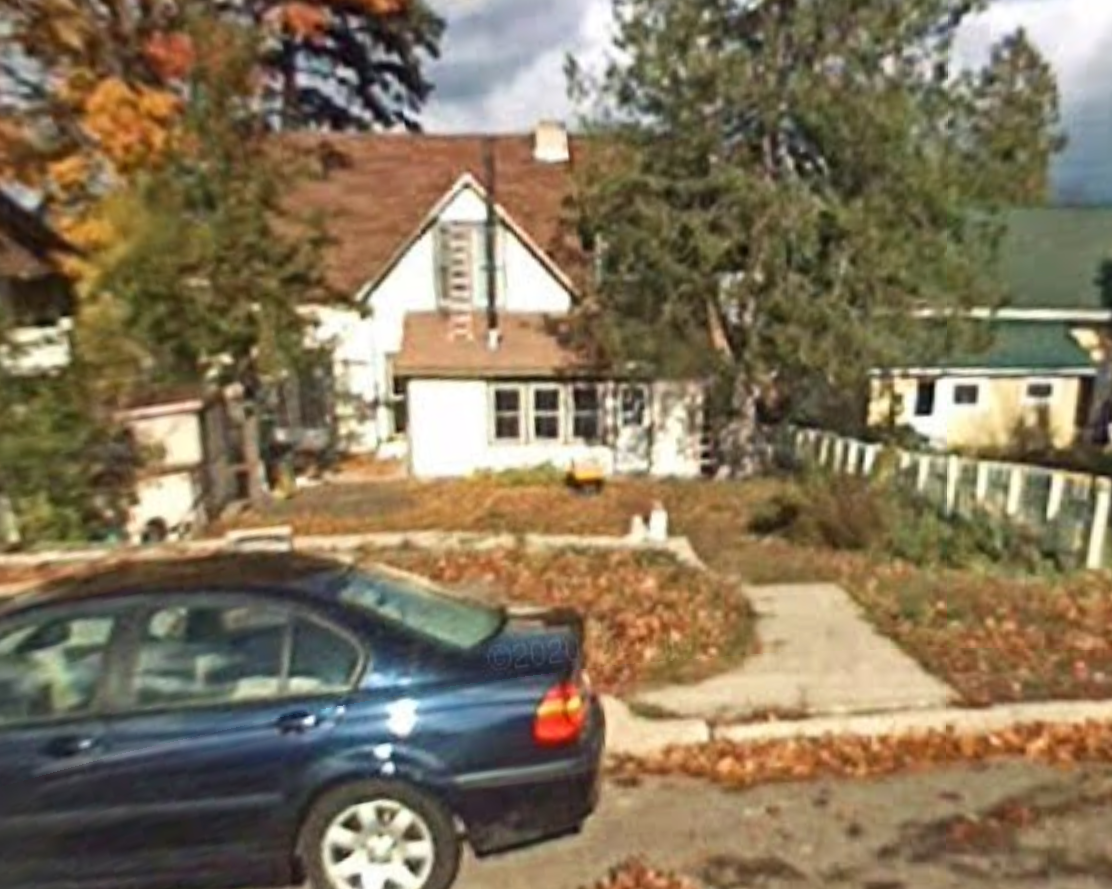
The house was built in the 1890s on a hillside near downtown Petoskey, MI. No one used the front door anymore, so the small addition off the back was the only way in and out. It was a frigid mudroom, apathetically stapled to the house—slabs of beige tile and drywall that were never trimmed or painted, leaking the warmth of the inside. Half the room was occupied by a glass table with chrome legs, leaving no entryway amenities. A half-step up from the tile is the dining room, with its soft tobacco-brown wood floors, hanging chandelier, and Victorian doorway trimmings—charm layered over a house that had already shown you its real temperament in the cold entryway.
Terra was terribly stringent about when we could visit, what food was available to us, which rooms were off-limits, where we could smoke, when we could play music, when we could draw the curtains, etc. Her paranoia was worse than Richard’s at times, and made watching them interact feel voyeuristic. One wasn’t quite sure whether they had an incestuous bond; her motherliness toward him was undercut by a sexual tension between the two, or if they were old business partners who lost it all in the crash, and now they spend their time on the farm. They simply had a bond that I didn’t understand, and I didn’t need to.
Besides Richard and me roaming in and out of the house, Terra kept a rotating cast of characters that felt carved out of myth. First was David J. Pickett, the reincarnation of Señor Picasso, mosaicist par excellence and house painter by trade. I still think about his stoned, dimpled, and giggling face when I think of home. Then there’s Kevin Barton: the Manoogian Museum’s Gold Medal Award winner, Signature Member of the American Impressionist Society, and Terra’s fuck-buddy. Kevin was a bat—strictly nocturnal, borderline feral.
Women were scarce in the house. Only her daughter—The Princess, as Richard and I called her—passed through occasionally, always leaving again for some distant trail, cliff, or river, organically repelled by her mother’s gravity.
When Richard first brought me to Terra’s House, it was a ceremonially staged ordeal— and I was repudiatively nervous.
Pinned to my lapel was a note that read:
‘Under the saintly stark sky, Alex cries to his beloved HANDS in agony for his unrequited pardon for an ego; still, navigating his flesh to a park bench in the only town in America with a cigar burn for a mascot should be manageable. —J’
I wore a lovely felt hat, brushed off my shoes, and smoked several joints before heading over. Terra had to ‘clear’ me, like a spiritual pat down. I had to be endorsed before I could use the house because of an energetic potential behind a kind of firewall. It was a ‘sensitive grid,’ and only particular ‘beings’ were allowed in the vicinity. Richard and I knew we needed access to the house for a launching pad/padded room. Old canvases, a spellbound foundation, secrets tucked into dressers, portals in dark hallways; it was all necessary to explore the truth behind identity and reality, the only frontier worth exploring.
We approached the front of the house, took the wobbling, uneven stone walkway around the side, then stepped through a white picket gate into the backyard. A plain concrete patio supported a petite, muscular middle-aged woman with dirty blonde hair, lying in a metal lawn chair, wearing a yellow bikini and cat-eye sunglasses. She looked over her shades at me with a skeptical glare that felt like an attempt to peer into my skull. She turned back to smile and laugh with Richard. He was her resident poet, boy-wonder, silver-tongue devil.
What I came to understand is that mediocrity was the forbidden disease— the one sin Terra would never forgive— and you were guilty until she decided otherwise. Richard adjourned inside, leaving us alone. I sat across from her and lit a cigarette, while she returned to sunbathing. She then began testing me with a series of seemingly innocuous but oddly assorted questions. One moment, it was Martín Del Río and his ‘hopeful satellites,’ the next it was proper gardening technique, or her theories about Van Gogh’s temperament. And threaded between them all was the silent, prolonged eye contact that felt like a psychic arm-wrestling match.
I felt like I was born to be there.
I didn’t miss a fucking beat, and I knew it. But it wasn’t enough. And while she did keep me around, it was mainly on Richard’s recommendation and my supposed ‘moldability.’ I think I shot myself in the foot because I refused to speak about my past—my family, my religious upbringing—and I think that silence made her wary. I tried to live in an eternal present, to let my past dissolve—but a man without a past is, by nature, suspect. My laissez-faire temperament was, it seemed, too Bohemian for her haute bohème daydreams.
Richard already had a room assigned to him, and eventually, I would too. Sometimes we stayed the night, but if staying over was a no-go (for whatever reason), he’d just walk home. I’d walk with him, wave as he slipped into his family’s house, then drift toward the downtown parking lot where my car waited, and drive it out into the woods— a hiding place I called home.
*
The principal way Richard and I bonded was through typewriter duels and long walks through the intellectual stratospheres of sociocultural form, hyperreal symbology, and their implicative substrates, which we traced through theories of collective consciousness. We were wild cards, back then. We spent our time playing with an entire town as if it were a psychic sand castle. This is a cautionary tale.
At each end of the dining table, our typewriters were locked and loaded; we each had ashtrays with rolled pipe tobacco mid-burn, and bottomless cups of black coffee. We were The Writers of The Code and The Disruptors in The Machine, ruling the world with a joint and a typewriter.
"tchick-tchick— — — tchick -tchick -tchick- tchick— — -tchick- tchick- tchick- tchick- tchick- tchick DING! …SHHHHOONK!”
In the living room, a record player would spin inspiration, most likely Dylan, Highway 61 Revisited was Richard's favorite, while tobacco smoke suffused the air. Pipe tobacco was the only smoke allowed in the house; weed or prerolled cigs were out of bounds— so said the landlord, the manager, Joe Pesci(Terra). So we took breaks and paced on the lawn while smoking joints, while throwing around those intellectualized magical thoughts that kept us on our toes. We were always wired, or working out a way to stay wired; the moment was happening, and if you weren’t tuned in, you were behind the eight-ball, which was as good as being dead.
Western culture no longer calls the shamanistic journey spirituality, even though it has historically been the basis for most spiritual belief systems. We have developed more demeaning language for it, i.e., a psychotic break, insanity, mental illness, schizoaffective disorder. And when I started experiencing this phenomenon in my early 20s, I had no idea what was happening. I did not have the language to describe my experience, nor the social support system to endure it. I started having more frequent breaks from reality, with visions that blurred the line between truth and surreality. The only person in my life who understood what was happening to me was Richard, my friend and fellow schizoaffective.
Richard and I were aware that if we had been born in another time or place, we would have been the shamanic leaders of our communities. But as it was, we were troublemakers roaming the town, finding trans-dimensional superhuman messages in dice, yellow lines, and pavilion spider webs. Olga Ravn said, “I don’t think of it in terms of piloting. We don’t fly under a sky here but through a slumbering infinity.” The place where we would ‘fly’ (one definition could be psychic interdimensional meddling) was either at the garden pavilion overlooking Little Traverse Bay, or at Terra’s House, tucked between Grove and Rush St. The pavilion was used for high-wattage transmissions. Terra’s house was good for typewriter duels in the dining room and running lines of code down the wires.
*
I memorized every patch of grass, the texture our pacing would wear, the weeds poking through the fence; every wilting flower in the unkempt garden, which Terra always insisted was doing well, but was in desperate need of fertilizer. Every flake of old paint on the garden shed/the smoking den, when it rained— It was cramped and dark, and our knees would be pressed together in the middle of the hut. The smell was a cacophony of ganja, gasoline, and vodka, with only the sound of each other’s breath to orient us as we came up.
We paced in circles, calling out strategies, shooting invisible arrows at the military recruiting center through the trees, talking with Oden, who would appear as a Raven, and then dictating the stock market with a boot scuff on the sidewalk. That was flying. Sometimes we would get interference from one system or another when they tried to hack our transmission. Then we would have to tag them for a trace that would usually get us a back door into some counterintelligence, but you had to be quick on the draw.
We were like brothers who developed our own language so no one else could understand us. But we were tapped into the mainframe of collective consciousness and had sufficiently encrypted our substrates, so full steam ahead was the only order coming down from ‘on high.’
*
This next part will not make linear sense—because back then, we didn’t. It’s an example piece, a hypothetical time capsule. Without the correct font or environmental factors, it will be forgiven its misgivings— it is a linguistic pattern meant to address uncertainty, chaos, and the unexpected philosophy of the peripheral sub/conscious experience—salad for the frail.
[LIVE]
Once you hear it(don’t worry about what, quite yet), it’s all you can listen to. It’s the most innate thing you’ve ever felt. It’s not a trick; it’s a glitch. But it’s not like a mistake; it’s worse than that. Better than a revelation, it’s a temperamental tectonic uneasy stomach.
But those are just the bends; the way through is always the way to you.
Please indicate arrangements have been made for payment.
- - - Thank you, Santorini.
Is there a better offer online, Sergeant? — Of course not.
‘That’s a clever old disease!’ said the manic eye^ to the nightwalker. ‘How should the drugs be used if we aren’t to talk with ourselves?’ And, of course, he was right. The young bookmaker was soft in the arms, but his instinct was correct. To be up with the gen-u-ine linguistic tremors is to be elbow-deep in business trips to the southernmost peninsula of Pangea in the morning and on through Ursa Minor in the evening.
#1 SAcnr #2 F NFN #3 WIW
“IN NEED OF AGENTS,” the sign read, then in walked this sad sack, desperate, trembling, talking about ‘be a part of something bigger than himself,’ — poor son of a bitch. I told’m what you told me. “While devotion is appreciated at the upper limit (the office), it is unnecessary and will be dealt with at some point—”
The longer the exposure, the higher the fidelity, within reason. To battle the mind and the matter without reason would be mad— slip out of mind and out of definition. Done by allowing minor inconveniences to slip the plot, the pondering, and the conversation. // To be aware and in control, relinquish and relish; everything is element. Tary not, to educate, you ask me…
SO GLAD TO HEAR FROM YOU, GLADYS! The best estimate would land the viewer somewhere between Islamic-controlled Cairo and the pressure point under Senator Biden’s chin.
The slippage of inter-dimensional variation is not accounted for in this diagram*
I cannot let it go... this emancipatory trembling. // I am crumbling into bits.
I can’t risk it. What if I don’t? What if I do? What if I bought a gun?
Now, we’re all asking dumb questions.
I think I can land this plane just fine.
OFFLINE—-------------JURY-------------TENENBAUM
Surely this song can’t last forever…
It already did? Samadhi.
(S) . red line, red line, blue, and the green ANGEL
Standing at my doorway, I will not let you in. I dream of silver hope that brushes against my hair, and will never again be the only place you can get a decent meal.
Tipping over the expectant bowl of grapes, until I find a boiled egg, a crooked leg, and a grey envelope with my body rolled tightly within.
Apollo, son of Zeus and Leto, I am.
Son of my own, made of my broken mind with the perfect in tow. I am the bridge of altercation, a space, a memory. To access the golden halo of import, I passed through many dimensions of --------REDACTED — ----- ----____ __ _______________. Apologies, I thought that would slip through the shields, but the file was ill-shaped (so says Mr. Dog). I can ‘only transfer essential files that are approved of by the prodigious conflation of meaning and time’(those complicitous brethren!). — Comedy
Stay awake. The primary goal of the navigator, the psycho-naut // plausibly deniable for any smooth-talking bastards still tuned in, but the truth is anything, the possible and impossible, and likely in the mind of him who believes(HEADS UP).
Example complete.
*
Terra would writhe through the house like a flame pacing its cage; going on late-night manic benders, cleaning everything, reorganizing the furniture, and kicking up the spirits that had been pooling in the corners of the old home. She once said I was the only other person she would allow to rearrange the space. It was the only skill she ever publicly acknowledged I possessed: Feng Shui.
Besides her manic episodes, her excellent temper made her exceedingly harsh about my piss-poor poetry and prim piano work. I was a creative infant, and she had no mercy or patience for my timidity or pensive gore. But I made it clear I was there to learn. I was not claiming to be A Great, just a hand reaching out.
The light-hearted frenzy of seemingly earth-shattering importance was a paradox. We would laugh, giddy as children, at the understanding of consciousness through the symbolic substrates of colloquialisms, hinting at messages from other versions of ourselves in parallel dimensions, since being an interdimensional being meant having memories stored across different planes(most of my time was spent opening those files). It was a continuous process intended to elevate the individual through the collective identity and out into whatever is on the other side of that curtain.