
The Ontology of an Art Briefcase
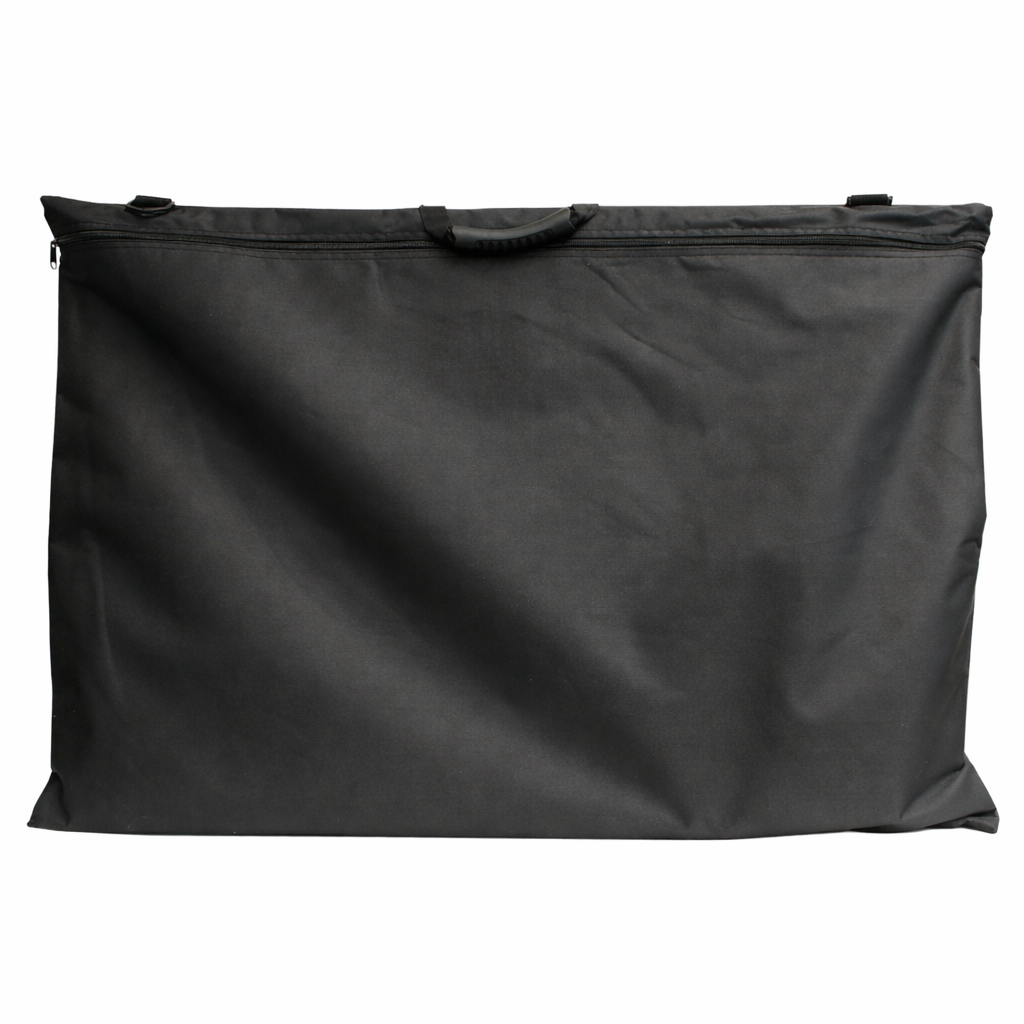
A few weeks ago, I bought a grey fabric wingback chair from Ikea. You probably know the one. It was the final piece of furniture for my living room. It’s so perfect, so quintessential, I think I’ll die in this chair. I have my legs crossed, and I’m kicking a 2-foot by 3-foot nylon art briefcase/bag with my big toe. The briefcase usually sits at the back of my closet, and I do my utmost to never think about it. Even the idea of unzipping it makes me unreasonably and unjustifiably annoyed— almost angry. My mind begins to race such that I can barely piece together my next action. What am I admitting?
I already know what’s inside, I think to myself. I don’t need to reopen this. I’m so determined that I already know what’s happening in my head — so damn sure of my own feelings, that an externalized internal dialogue feels more comfortable to me than trying to be forthcoming. Sure, it’s been a long time since I’ve opened it, but there’ll be no surprises. I can tell you precisely what's inside, and I don’t have to go through whatever exercise this is.
My operant truth regarding the primary content in the briefcase is a memory of my acceptance into the Penny Stamps School of Art & Design. However, central to that is a pain of loss because I couldn't accept it, since I was unable to afford the mandatory study abroad program. That memory is what I’ve long decided is hidden away in this briefcase. I keep it as a kind of depressing trophy. A reminder that I was good enough to get accepted into art school, but hidden away because I had to reinvent myself— reorientate my career path, refocus my identity away from yet another failed attempt to fly, [insert metaphor here].
But that singular meaning for the briefcase has made me feel like I have a coffin buried in my closet, making me some kind of twisted and troubled soul! One that would stash a body without a proper burial— like a primate mother clinging to their dead child, dragging it around for weeks, unwilling to accept its death. However, a beginning is compelled to contain its ending. The part that sees something more is Homo Erectus, the one who no longer fits in with their cousins, who are still clinging to the edge of the jungle.
After considerable hand-wringing, I roll my eyes at myself and pull the first item out of the bag: an XL drawing pad, approximately 18 inches by 24 inches. Like most things in this bag, I acquired it during my time at Washtenaw Community College, while pursuing my Associate's Degree. The class this bag was bought for turned out to be the first and only art class I’d ever take. Everything I did is in charcoal—charcoal is, by nature, messy, gestural, moody, and full of depth. — I took to it like a charm.
My eyes quickly fell to one of my first ‘assignments,’ a sketching of a deer skull with a fedora balancing atop it. I could barely look at it. I glanced at it as if someone were standing over my shoulder, and it was the centerfold of a Playboy magazine.
*
While on my first solo trip south of Michigan, I stopped to take a piss in the woods and found myself near some train tracks. Not far off, I saw half of a wonderfully arid deer skeleton. I considered it an omen that my trip had been blessed by some forest spirit (or whatever schizoaffective language I was using at the time). I took the skull and jawbones as a bauble for my ’04 Subaru Outback. I jammed the skull between the windshield and dashboard, but the jawbones were loose, so they slid around the dash. I tried my best to keep them all together as a set, but the jaw bits eventually found their way into the void. Recently, the skull became a gift for a friend who was an avid bone collector and still believed in the forest spirits.
The Fedora, which I eventually fell out of fashion with and gave to the Salvation Army, was a gift from a dear friend, Jenna. I can still remember the smell of her warm, fresh cardamom perfume on her pillows. We slept on a mattress on the old wooden floor of an apartment in Knoxville, TN, with a small balcony overlooking the gray, sleepy town. I began writing immersive poetry that autumn season, sitting on her floor, hammering away on my Olympia Deluxe typewriter, hour after hour. It was the start of something deeply therapeutic and profoundly honest. I wish I could say I remembered what happened between Jenna and me. But time and the river had their own plans for us. We were never lovers, but I loved her. It was a season for sexual healing, frolicking aside.
*
Like a slingshot, I’m back in my perfect wingback chair. Mechanically, like a claw machine in an arcade, I reach back into the briefcase and retrieve the next drawing pad. It’s protecting a heavily sun-kissed sketch that is approaching a light orange, its texture now crispy and rippled. It’s the upper half of a skeleton from behind, which I had sketched while living in Petoskey, MI, my hometown. However, I mostly remember it on the wall of my home in Ypsilanti; Built back in 1905 on Ballard Street, the house was a haunted relic which had apparently become my aesthetic. I moved there with Anne, a rich girl who wanted to be a commoner, like me.
We shared the house with Phil and his partner, Mary. Phil was attending the Taubman School of Architecture. I knew him from Northern Michigan and had even been roommates with him a couple of years prior in Good Hart, MI. If you’ve ever been to Good Hart, particularly during the winter, you’d know that a stout survival instinct is not a virtue, but a necessity. Years before I moved to Knoxville or Ypsilanti, I roomed with Phil in an old farmhouse that lacked central heating for one winter season. It was where I would eventually outlast the Outback.
The only automatic process that kept the house warm was us, dragging our asses(mine and Phil’s) out of bed on rotation to stoke the fire. And I know what you’re thinking. “Automatic means self-operating — that’s the wrong word, you must mean manual.” To which I reply, ‘autos,’ is from the Greek ‘a tos,’ meaning ‘self,’ and ‘-matic,’ from the Greek ‘matos,’ meaning ‘willing to.’ Now, ‘-matic’ shifted over time to mean something like ‘related to, or performing an action,’ which I appreciate, but ‘auto’ still means ‘self.’ Which we now use to mean self-operating, but my skin crawls to think that if I, the self, was stoking a fire at 2 a.m., was not ‘the self’ performing an action, and therefore, automatic. I digress.
*
There were three of us who lived in the old farmhouse. I, going by Jeffrey at the time, had the room at the top of the stairs, Phil, my good friend, was down the hall from me, and Darwin, a recluse, lived on the first floor right off the main room where the fireplace was. Despite his proximity to the fireplace, only Phil and I took care of the fire, and for the life of me, I don’t remember why. I don’t even remember his real name; I just remember that he kept all his windows boarded up, and he hardly ever left his room (his shell). I did hear tales of his days as a psychonaught when he was a young man, so that, combined with his turtle-like nature, his nickname would either have to be Galapagos or Darwin. Darwin won by a 90% margin.
Phil was a tall, lanky dove of a man. He floated through every room like a breeze. He wore knee-high soft leather moccasins, a brown Carhartt jacket, and yellow leather mittens. His hair was shaved on each side but long on top and down the back. He played the flute, collected feathers and driftwood, ate organically, slept like a corpse, practiced light magic, and a part of him really did believe he’d never die. We’d have cosmic duels on stormy nights. He’d be in his room, I'd be in mine. He, the lightworker, would summon angels and scribe maps for enlightenment. I, the demon host, would be opening gates, setting forest spirits free, and eating ash. All in good fun, of course.
Around 2 a.m., after stoking the fire and placing the remaining logs into the flames, I quietly shuffled through the living room and out of the kitchen, down a couple of planks to a covered woodshed loosely attached to the house. When the temperature drops to 20-30 degrees below zero, it's helpful to have your firewood nearby and dry. I propped the shed door open and sat on a fold-out chair, watching the snow fall across the 20 acres of open field. My hands were cold, so I took turns putting one in each respective pocket while the other held a burning cigarette.
It was silent, except for a soft crackle when I would inhale the burning tobacco, and the soft plomps of large snowflakes as they hit the frozen sawdust floor of the shed. The silence of the cold country air is desolate and beautifully haunting. The night glowed as the sky kissed the ground relentlessly. I felt a hundred feet tall. I felt like one of the stars had reached down and pulled on my spine.
Once the cigarette burned out, I took a couple of logs in and set them up longways on the hearth so they would be dry for the next stoking shift.
When morning came, it had stopped snowing, and everything was again buried in feet of snow. I went out to begin clearing a path, cleaning the cars off, and so on. Eventually, I made it around to starting up my decades-old Subaru Outback, which had carried me across country several times now, but it wouldn’t start.
It was complete engine failure.
I was heartbroken, even though I should have seen it coming. I was abysmal at tending to the car, even though it had been my home, and I should have taken better care of it. But, between addiction and several mental health disorders, I did not have the bandwidth to maintain a vehicle properly. That poor ol’girl never once received an oil change. So, I was stranded once again, but severely so. I called a junkyard, and they paid me a whopping $500 to haul it away (a bit less than they would have charged simply because of my remote location and the poor road conditions).
After they came and hauled it away, I went up to my room, sat down in an old wooden rocking chair that had been there since I arrived, and began the process of detangling. Like pulling spider webs off of your clothes and out of your hair after walking through a dark shed. Or stacking wood, centered solely on the logic of its stability.
What do I keep?
What did I leave behind?
What did I need?
What do I throw away?
What’s important to me?
Why is it important to me?
But now, a more crucial question arose. Since I would no longer have a place to live come the spring, per my informal contract and the desecration of my spaceship:
What can I carry on my person?
*
I have now migrated from the chair down to the floor. The briefcase is leaning against the bookshelf, and I have a pile of loose papers not-so-neatly stacked between my legs. They are as follows:
A still life of a bottle, a cork, and pieces of wood
Abstract // pen on paper
A doorway? (I think the intention toward the minuscule details and the aesthetic sensation that entreats the observer who interacts with it is real)
A print of a Michelangelo study with purple and blue paints rubbed and smudged on it (sexy?)
A calendar page for February 2023, but the image on the backside is for March, titled 'Stretching Time' by Dennis Kester, 2005. It depicts a woman riding a crow; her face is morphing, and there are wavelengths between her hands (I see the spirit).
A charcoal self-portrait, geometric profile, and front view all in one(a favorite that I have mistreated, and yet it persists).
A newspaper clipping from the New York Times, August 15, 2019. The article is about Dr. Carl Weiss Jr., 84, who had sought to clear his father’s name, and is being reported as having died. There’s a sketch showing a scene of chaos in a hallway; bullets flying, people fleeing, the scene of the assassination. (I believe I was his father)
A print of the Canon of Proportion; Venice, Academy of Fine Arts, page 126 in Da Vinci’s notebook showing the Venus de Milo. (I was Apollo)
Abstract portrait // pen on paper
Abstract // pencil on paper
A poster for the album Contra by Vampire Weekend, from the vinyl album (I think that we’re all curating boxes of belongings that people will pick through and analyze when we die)
A Negative of a self-portrait in acrylic on paper, signed JSB, for Jeffrey Scott Blacke, my name for 4 years.
A small music poster of Labrinth, Sia, and Diplo for LSD “Audio” and “Genius” (I’m hoping you know what I mean, so I don’t have to confess it like a believer)
*
My Sunday school papers were tightly pinched in my hand. My shirt had been untucked since the exact moment church ended, and my clip-on tie was in my pocket. I jumped out of the back seat of our golden Chevy minivan and tried my best to clear the middle seats and land on the driveway in my clunky brown leather church shoes all in one swift gymnastic swing, swivel, adjust, toes out, and—‘he lands it!’
I ran up the path to the house, lay my body into the door, put my weight on the handle, and THMP— it’s locked—‘those overprotective parents…no one is going to break into our house! We live in the middle of nowhere, in the woods! And it isn’t like we have anything anyone would want to steal. Those parents, they’re always so paranoid—’
I’m like a race dog, my senses abuzz in my trap as I press my nose into the corner of the door, waiting for the lock to move out from the doorframe, hang fire for the starting box to swing open. I suppose my lure must have been the smell of the crock-pot that had been going since seven that morning. My father tells me to back up so he can get the key into the lock. He opens the door, but reluctantly— so that I’d be annoyed, no doubt.
As fast as I could, hopefully quicker than last week, I whip my shoes off, grab them and put them in line with the others (otherwise Mom would make me redo this whole intro routine and I didn’t have time to waste on that nonsense), tip-tapping, I would run across the room, careful to not shake to China Cabinet(Moms Fine Dining set), I’d spin around and throw my back against the rear door, then thrust myself down the stairs which my feet would barely touch. I practically flew down them. Then, I’d take a hard right and aim my nose for my room, where I’d dive toward my bed and throw my arm underneath it, where I would leave all my Sunday school papers, projects, doodads, and artifacts, as well as any take-home work from every church event we had. Luckily, my mother made us use bed skirts so those handfuls of compost would stay hidden for quite a long time.
Eventually, however, my mother did clean my room, even though I had told her not to. Mothers can be such mothers, sometimes. She pulled out trash bags full of papers with crayon scribbles, papers with macaroni glued to them, papers with pipe cleaners glued to them, papers with cotton balls glued to them; you get the idea.
“Why are you saving all this stuff?” she asked me, as if she didn’t make me feel like I was supposed to hang on to everything I got from church. It was a veritable minefield of sociopolitical expectations, much like figuring out when to discard a birthday card.
My solution was to keep everything.
*
After cataloging each page, I tucked the pile of loose papers back into the art briefcase as quickly as I could, assuring myself that I was no longer that anxious little boy. And while I’ve always been obsessive about my things, I did eventually study Fung Shui and aesthetics, get diagnosed with OCD, and medicated for several anxiety disorders. Nothing really began to get better until I got sober and properly medicated. Relationships, likewise, always seemed to end either abruptly or poorly before I was emotionally regulated. The correlation between the loss of my social relationships and the loss of my belongings was nearly one-to-one for many years.
There was not much else hiding in the final sketchbook of my art briefcase. However, it did contain some original artworks that are now framed and hang on my wall. They are two of only three pieces that have survived my aesthetic preference evolution. The first is a charcoal profile of a woman. The woman has hooded eyelids; her hair is in a parted bob cut. She has beautiful, smooth skin, a sharp jawline, and a delicate neck. The second is the portrait of an old man, also in charcoal. The old man appears to be nearing the state of a ghost. He is smudged and smeared, his eyes sunken so deeply into his skull that only darkness remains—a haphazard and chaotic beard attempts to offer warmth, if not a welcoming wind, ripped air.
My first consideration in the resurfacing of particular memories during the unpacking of this briefcase was to seek clarity about the loss of the relationships to which those memories were tied, particularly Phil. He had just gotten married, as I learned from some photos on Facebook, and I was feeling especially distant. But I know that I tend to suppress the memories of why something went wrong in favor of the good memories I had of them. So what if my answer for what’s in this bag isn’t in this bag? What if it’s not about the Phil, or even my art school admission? What if my saved objects aren’t testaments, but something much more ordinary?
*
The final time I attempted to stay with my parents at their home, I was explicitly there to retrieve anything they might have in their possession that was once mine. But on a more personal level, I was there trying to get some space from a very complicated three-way relationship I had been invited into, which had resulted in a divorce. Since I was its catalyst, I felt that I needed a leave of absence. And since parents had recently renovated their spare room, and I had important work to do that required isolation, I took the bait.
I was in the middle of recording my third piano album. I primarily used these albums as resumes for my clients, since I worked as an event pianist at the time. However, this project was becoming abstract—it was called "Two Spiders." I experienced a kind of dysmorphia where I intentionally developed a dissociation from my hands, then watch them move across the keyboard like foreign entities. All day, on repeat, I would stick my head out the window and smoke weed, watch my keyboard be played, write abstract poetry like a madman trapped in an asylum, and listen to Beatles albums like they were lectures by Richard Feynman.
While I was there, I began working on an idea for a science fiction novel. One in which the Earth became conscious and could communicate with all living beings. There was a comprehensive system of off-world organizations dedicated to higher dimensions and futuristic technology, primarily focused on advancing consciousness. But my first mistake was being excited about it. My second mistake was telling my father about it.
My parents did not believe in Fung Shui; they both had undiagnosed OCD, neither of them was an artist, actively discouraged my art as a boy, and were vehemently opposed to any non-Christian way of thinking. I don’t recall the exact words that were exchanged. Still, I remember we argued like primates, flinging our feces at each other from across the room. Neither of us would give an inch to the other. My excuse was that he raised me that way. His primary concern was my brazen support for and belief in evolution. He refused to let me stay in the house if I continued to think and write the things I insisted on thinking and writing.
“You mean the evolutionary ideology of global interconnected consciousness?!” I said, lordying myself over his simple-minded religiousity.
However, we were having two different conversations, and neither of us had any intention of bending or empathizing with each other.
My father went to his room, sulking, while I packed my things as quickly as I knew how. Then I went to find my father, who was pensively standing at his window, somberly looking into his backyard. I walked up beside him and asked if he thought I was doing anything that Jesus would not have done. My father was a minister, so I was trying to use his language. After all, Jesus famously spent time with prostitutes, drunks, the homeless, and the sick. But my father never looked at me or said a word. I stumbled through a version of Luke 14:26 about hating your father and mother to be a disciple, but I just said 'leaving,' not ‘hate.’ Still— nothing.
I walked away and took my things onto the porch. They left for their Wednesday night church service.
I chain-smoked cigarettes until Sarah, the divorcée who might have been my girlfriend, showed up. I didn’t have time to put that relationship into a bottle. When she pulled up, I loaded my things into her car, including a couple of boxes my parents had kept for me.
“There’s no way I’m leaving them with this ammo,” I said. “Not if I can help it.”
“What’s in the boxes?” she asked.
“It doesn’t matter,” I said. “It’s trash.” I leaned back into the passenger seat, slid my hand into hers, and turned up the radio.
*
I’ve picked myself up off the ground, with more discomfort than I care to admit. For a moment, I awkwardly sway in place like the pier of a bridge, undergirding its superstructure. Having torn down nearly everything in my life on several occasions, I learned to call myself a minimalist. But over time, I’ve come to admit that I actually enjoy having things, despite my attempts to convince myself otherwise. My time without creature comforts allowed me to meditate on the associations and beliefs we use to define our environments. It provided me with the freedom and self-drawn blueprints to reconstruct my social architecture.
The way my briefcase has been working so far has been to conjure up memories from the contents of its intestines, which I then pick through like a gastroenterologist. But this memory — of being unfit for my family — is pushing me back into another piece of art, the third to survive my aesthetic dilation. The piece of art that was never going to fit into the briefcase. Composed of house paint and spackle on a stretched canvas, it measures approximately 3 feet tall by 4 feet wide. It was framed by a local artist in Old Town Ypsilanti and has dimmable lighting mounted onto the frame. It’s a pollock study, called Atomos.
When I painted it in my little studio on the second story of the house on Ballard Street, I was terrified. But primarily because of the large, black splotches that would become the focal points. I knew I had one throw to make each of them real, and that there would be no redo. My hands shook, and my heart raced as I stood over the canvas, holding a stick submerged in a bucket of house paint. I knew that the space between the end of that stick and the canvas was entirely out of my control. And when I threw the paint, I had to let it become whatever it might become. When Atomos arrived in my art studio that day, I was reborn.